
New Combi Boiler Warrington: What Can Change the Recommendation?
What determines the right combi boiler for a home? Choosing a new boiler is not simply about finding the highest output or the cheapest appliance. A combi boiler needs to match the heating and hot water demands of the property, while also working effectively with the existing plumbing, gas supply and heating system. For homeowners…

Why you can trust our content
We understand that the boiler industry can be confusing, with plenty of outdated or misleading information. That’s why we rely only on trusted, proven sources to guide our advice and installations:

At a glance
What determines the right combi boiler for a home?
Choosing a new boiler is not simply about finding the highest output or the cheapest appliance. A combi boiler needs to match the heating and hot water demands of the property, while also working effectively with the existing plumbing, gas supply and heating system.
For homeowners considering a new combi boiler in Warrington, the recommendation can change considerably depending on how the property is used. A small house with one bathroom and modest hot water demand may need a very different solution from a larger family home with several occupants using hot water at the same time.
The installation itself matters too. Available space, pipework, water pressure, flue arrangements and controls can all affect which boiler is suitable.
Why does household hot water demand matter?
One of the biggest considerations with a combi boiler is how much hot water the household needs at busy times.
A combi boiler heats water directly when a tap or shower is turned on, so it does not store a large volume of hot water in a cylinder. Its ability to provide hot water therefore depends on the appliance output and the incoming water supply.
Households should consider:
- How many people live in the property
- How many bathrooms are regularly used
- Whether showers and taps are used at the same time
- Typical morning and evening routines
- Whether a bath is used frequently
- How quickly hot water needs to be available
- Whether household occupancy is likely to change
A boiler that is perfectly adequate for one or two people may feel less suitable for a busy household with several simultaneous demands.
This is why the recommendation should reflect actual usage rather than simply the number of bedrooms.
Can the size of the property change the recommendation?
Yes, although property size is only one part of the calculation.
A larger home will generally have a greater heating requirement, but insulation, windows, room layout, extensions and radiator sizes also affect heat demand.
For example, a well-insulated three-bedroom property may require less heating capacity than an older property of a similar size with significant heat loss.
A sensible assessment therefore considers the building as a whole.
|
Property factor |
Potential impact on the recommendation |
|
Number of bedrooms |
Provides an initial indication of heating demand |
|
Property size |
Helps establish the likely heating requirement |
|
Number of bathrooms |
Can influence hot water demand |
|
Household size |
Indicates likely simultaneous usage |
|
Insulation |
Affects heat loss and boiler demand |
|
Existing radiators |
Helps determine whether the heating system is suitable |
|
Incoming water supply |
Can affect combi hot water performance |
|
Gas supply |
Needs to be suitable for the proposed appliance |
This approach avoids selecting an appliance based on a single measurement.
Does mains water pressure affect a combi boiler choice?
It can be very important.
A combi boiler does not create additional water pressure. Its hot water performance is influenced by the incoming mains supply and the flow available to the property.
If the incoming supply has limited flow, installing a larger combi boiler will not necessarily solve the problem. The appliance may have the capacity to heat more water, but there may not be enough incoming water available to deliver the expected flow rate.
An installer should therefore consider the property’s water supply before making a recommendation.
This is particularly relevant for households expecting strong shower performance or wanting several hot water outlets to operate comfortably.
A proper assessment can identify whether the existing supply is likely to support the proposed system and whether another type of hot water arrangement might be worth considering.
When might a combi boiler not be the best option?
A combi boiler can be an excellent choice for many homes, but it is not automatically suitable for every property.
An alternative system may be worth considering where:
- Hot water demand is particularly high
- Several bathrooms are used simultaneously
- The incoming mains supply is limited
- A property already has a suitable hot water cylinder
- Household usage makes stored hot water advantageous
- There is sufficient space for a cylinder and associated equipment
The objective should be to choose a heating and hot water system that fits the way the property is actually used.
That means an installer should be willing to explain when a combi is appropriate and when another arrangement could make more sense.
How does the existing heating system affect the recommendation?
The existing system can reveal important information about what may be needed during the replacement.
Radiators, pipework, valves, controls and the condition of the heating circuit should all be considered. An old system may have accumulated sludge or corrosion, which can affect the performance of a replacement boiler if the system is not properly prepared.
The boiler position also matters. A replacement in the same location may be relatively straightforward, whereas moving the appliance could require changes to gas, heating, water, condensate and electrical connections.
For this reason, combi boiler installation Warrington should be planned around the entire system rather than the boiler alone.
The installer should explain any recommended preparation work and identify whether it is included within the quoted scope.
Could the boiler location change what is recommended?
Yes. The location can affect both practicality and installation cost.
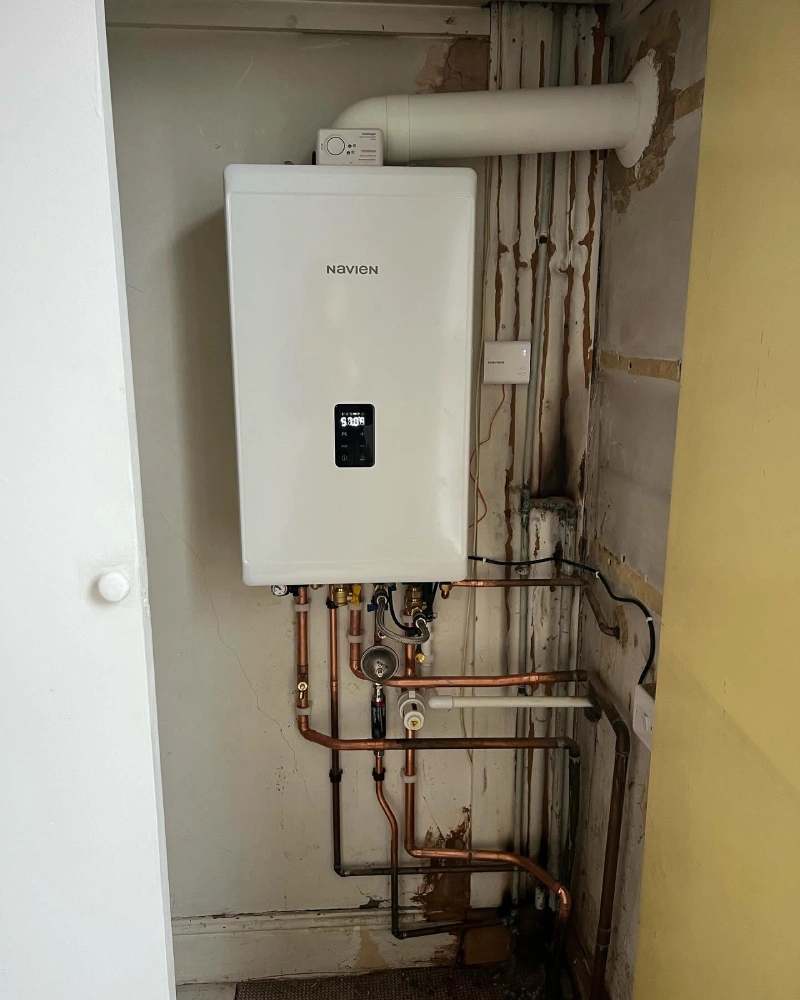
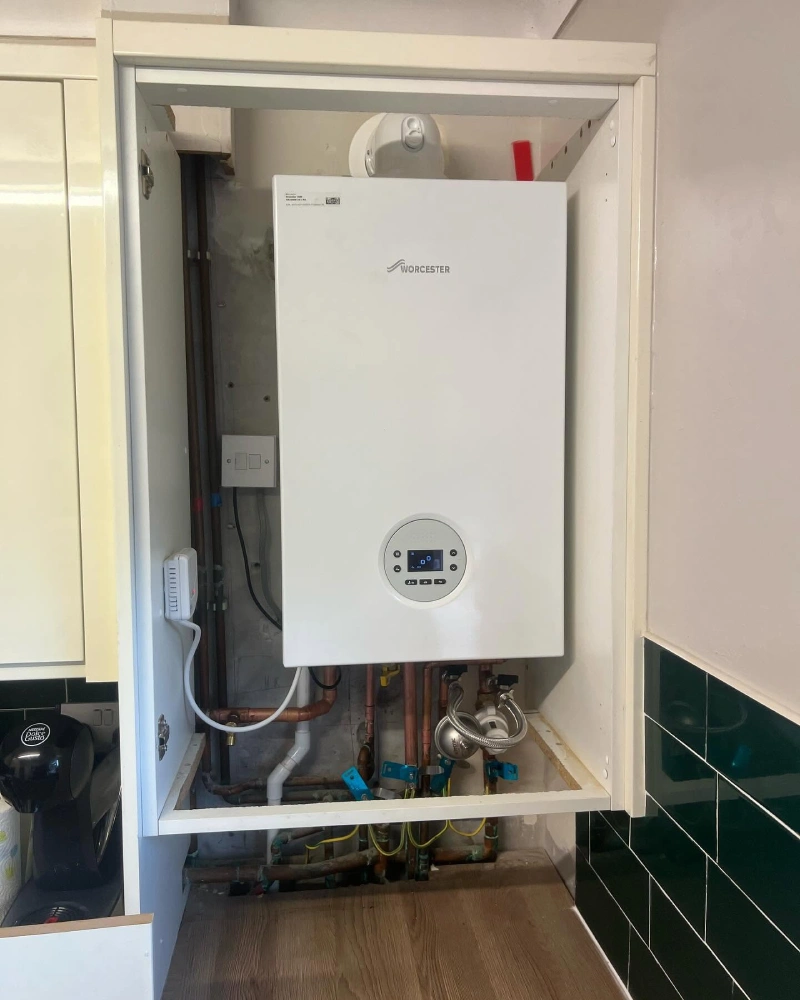
A homeowner might want a boiler moved into a cupboard, loft space or another part of the property. Before this is agreed, the installer needs to consider access, ventilation where applicable, servicing requirements, flue routing, condensate drainage and the position of existing services.
The most visually convenient location is not always the most practical.
An assessment can compare possible positions and establish whether moving the appliance creates additional work.
For a homeowner, this is useful because it allows the decision to be made before installation rather than after the project has started.
Do boiler controls make a difference?
They can.
Modern heating controls can help homeowners manage when and how their heating operates. Depending on the system and property, options can include programmable thermostats, room thermostats and smart controls.
The right control arrangement depends on the boiler, heating system and household preferences.
A replacement is therefore a useful opportunity to review whether the existing controls are still suitable. Simply installing a new boiler while leaving an outdated control arrangement may mean the heating system does not provide the level of control the homeowner expects.
Ask for the controls to be clearly listed in the quotation so you know exactly what is included.
What happens if the existing gas pipework needs changing?
A new appliance may have different requirements from the boiler it replaces.
During the assessment, the installer should consider the existing gas pipework and whether it is appropriate for the proposed appliance and installation arrangement.
If alterations are required, they should be identified before the work begins wherever reasonably possible.
This is another reason why comparing boiler prices based only on the appliance itself can be misleading. Installation requirements can vary between properties, even when homeowners choose the same boiler model.
A detailed assessment provides a better basis for understanding the overall project.
Let’s get started, Which fuel powers your boiler?
Mains Gas
LPG
Other
It just takes 60 Seconds
And then you can book a free consultation
Can future household changes affect the choice?
They can, particularly if the household expects its hot water requirements to change.
For example, a couple living in a property today may have relatively modest demand. If they expect the household to grow or intend to use additional bathrooms more frequently, the future requirement may be different.
Similarly, a homeowner planning an extension should consider whether the heating and hot water system will still be suitable once the work is completed.
The best recommendation considers not only how the property is used today but also any realistic changes that are already being planned.
A typical Warrington home scenario
Consider a three-bedroom semi-detached property with one bathroom and two occupants. The existing boiler is approaching the end of its useful life, and the homeowners want a replacement before reliability becomes a problem.
Initially, a combi boiler appears to be an obvious choice. However, an assessment finds that the incoming water flow is lower than expected and the homeowners are also planning to convert part of the property into an additional bathroom.
Rather than automatically selecting a higher-output combi, the installer discusses how the planned changes could affect future hot water demand. The homeowners can then compare their options with a clearer understanding of the practical implications.
This illustrates why the first recommendation should not be based solely on the existing boiler.
How should homeowners compare combi boiler recommendations?
When different installers recommend different boilers, ask each one to explain the reasoning behind the recommendation.
Useful questions include:
- What heating output does the property require?
- Why is this boiler suitable for the household’s hot water demand?
- Has the incoming water flow been checked?
- Is the existing gas supply suitable?
- Will the existing radiators and pipework be retained?
- Does the heating system require cleaning or preparation?
- Are new controls included?
- Is the proposed boiler location suitable for future servicing?
- Are there any additional installation costs that could arise?
- What work is included in the quotation?
A reputable installer should be able to discuss these points without making the homeowner feel pressured into a particular model.
Is the highest-output combi boiler always the best choice?
No. Bigger does not automatically mean better.
For heating, an oversized boiler may provide considerably more capacity than the property needs. For hot water, however, output can influence the flow rate the appliance can achieve, subject to the available incoming water supply.
The recommendation therefore needs to balance heating demand, hot water demand and the property’s infrastructure.
Choosing the largest appliance available without considering those factors can result in a system that is not properly matched to the home.
What should be included in a combi boiler installation quote?
A clear quotation should identify both the boiler and the work required to install it.
Ideally, homeowners should be able to see:
- Boiler make and model
- Boiler output
- Controls included
- Removal of the existing boiler
- System preparation or cleaning
- Flue work
- Pipework alterations
- Condensate arrangements
- Commissioning
- Waste disposal
- Warranty information
- Any exclusions
This makes it easier to compare different proposals fairly.
When considering a new combi boiler in Warrington, avoid making the decision solely on the initial price. A slightly different quotation may include work that another installer has left outside the headline figure.
Final thoughts
A combi boiler can be a practical and efficient solution, but the right appliance depends on more than its advertised output or purchase price.
For homeowners planning new combi boiler Warrington work, the property’s heating demand, hot water usage, water supply, pipework, boiler location and future plans all deserve consideration before a final recommendation is made.
Boilerable can help homeowners understand those factors and make a more informed decision. If you are considering replacing an existing boiler, speak to our team for tailored guidance and a clear installation scope.
Related articles

Let’s get started, Which fuel powers your boiler?
Mains Gas
LPG
Other
At a glance
What determines the right combi boiler for a home?
Choosing a new boiler is not simply about finding the highest output or the cheapest appliance. A combi boiler needs to match the heating and hot water demands of the property, while also working effectively with the existing plumbing, gas supply and heating system.
For homeowners considering a new combi boiler in Warrington, the recommendation can change considerably depending on how the property is used. A small house with one bathroom and modest hot water demand may need a very different solution from a larger family home with several occupants using hot water at the same time.
The installation itself matters too. Available space, pipework, water pressure, flue arrangements and controls can all affect which boiler is suitable.
Why does household hot water demand matter?
One of the biggest considerations with a combi boiler is how much hot water the household needs at busy times.
A combi boiler heats water directly when a tap or shower is turned on, so it does not store a large volume of hot water in a cylinder. Its ability to provide hot water therefore depends on the appliance output and the incoming water supply.
Households should consider:
- How many people live in the property
- How many bathrooms are regularly used
- Whether showers and taps are used at the same time
- Typical morning and evening routines
- Whether a bath is used frequently
- How quickly hot water needs to be available
- Whether household occupancy is likely to change
A boiler that is perfectly adequate for one or two people may feel less suitable for a busy household with several simultaneous demands.
This is why the recommendation should reflect actual usage rather than simply the number of bedrooms.
Can the size of the property change the recommendation?
Yes, although property size is only one part of the calculation.
A larger home will generally have a greater heating requirement, but insulation, windows, room layout, extensions and radiator sizes also affect heat demand.
For example, a well-insulated three-bedroom property may require less heating capacity than an older property of a similar size with significant heat loss.
A sensible assessment therefore considers the building as a whole.
|
Property factor |
Potential impact on the recommendation |
|
Number of bedrooms |
Provides an initial indication of heating demand |
|
Property size |
Helps establish the likely heating requirement |
|
Number of bathrooms |
Can influence hot water demand |
|
Household size |
Indicates likely simultaneous usage |
|
Insulation |
Affects heat loss and boiler demand |
|
Existing radiators |
Helps determine whether the heating system is suitable |
|
Incoming water supply |
Can affect combi hot water performance |
|
Gas supply |
Needs to be suitable for the proposed appliance |
This approach avoids selecting an appliance based on a single measurement.
Does mains water pressure affect a combi boiler choice?
It can be very important.
A combi boiler does not create additional water pressure. Its hot water performance is influenced by the incoming mains supply and the flow available to the property.
If the incoming supply has limited flow, installing a larger combi boiler will not necessarily solve the problem. The appliance may have the capacity to heat more water, but there may not be enough incoming water available to deliver the expected flow rate.
An installer should therefore consider the property’s water supply before making a recommendation.
This is particularly relevant for households expecting strong shower performance or wanting several hot water outlets to operate comfortably.
A proper assessment can identify whether the existing supply is likely to support the proposed system and whether another type of hot water arrangement might be worth considering.
When might a combi boiler not be the best option?
A combi boiler can be an excellent choice for many homes, but it is not automatically suitable for every property.
An alternative system may be worth considering where:
- Hot water demand is particularly high
- Several bathrooms are used simultaneously
- The incoming mains supply is limited
- A property already has a suitable hot water cylinder
- Household usage makes stored hot water advantageous
- There is sufficient space for a cylinder and associated equipment
The objective should be to choose a heating and hot water system that fits the way the property is actually used.
That means an installer should be willing to explain when a combi is appropriate and when another arrangement could make more sense.
How does the existing heating system affect the recommendation?
The existing system can reveal important information about what may be needed during the replacement.
Radiators, pipework, valves, controls and the condition of the heating circuit should all be considered. An old system may have accumulated sludge or corrosion, which can affect the performance of a replacement boiler if the system is not properly prepared.
The boiler position also matters. A replacement in the same location may be relatively straightforward, whereas moving the appliance could require changes to gas, heating, water, condensate and electrical connections.
For this reason, combi boiler installation Warrington should be planned around the entire system rather than the boiler alone.
The installer should explain any recommended preparation work and identify whether it is included within the quoted scope.
Could the boiler location change what is recommended?
Yes. The location can affect both practicality and installation cost.
A homeowner might want a boiler moved into a cupboard, loft space or another part of the property. Before this is agreed, the installer needs to consider access, ventilation where applicable, servicing requirements, flue routing, condensate drainage and the position of existing services.
The most visually convenient location is not always the most practical.
An assessment can compare possible positions and establish whether moving the appliance creates additional work.
For a homeowner, this is useful because it allows the decision to be made before installation rather than after the project has started.
Do boiler controls make a difference?
They can.
Modern heating controls can help homeowners manage when and how their heating operates. Depending on the system and property, options can include programmable thermostats, room thermostats and smart controls.
The right control arrangement depends on the boiler, heating system and household preferences.
A replacement is therefore a useful opportunity to review whether the existing controls are still suitable. Simply installing a new boiler while leaving an outdated control arrangement may mean the heating system does not provide the level of control the homeowner expects.
Ask for the controls to be clearly listed in the quotation so you know exactly what is included.
What happens if the existing gas pipework needs changing?
A new appliance may have different requirements from the boiler it replaces.
During the assessment, the installer should consider the existing gas pipework and whether it is appropriate for the proposed appliance and installation arrangement.
If alterations are required, they should be identified before the work begins wherever reasonably possible.
This is another reason why comparing boiler prices based only on the appliance itself can be misleading. Installation requirements can vary between properties, even when homeowners choose the same boiler model.
A detailed assessment provides a better basis for understanding the overall project.
Let’s get started, Which fuel powers your boiler?
Mains Gas
LPG
Other
It just takes 60 Seconds
And then you can book a free consultation
Can future household changes affect the choice?
They can, particularly if the household expects its hot water requirements to change.
For example, a couple living in a property today may have relatively modest demand. If they expect the household to grow or intend to use additional bathrooms more frequently, the future requirement may be different.
Similarly, a homeowner planning an extension should consider whether the heating and hot water system will still be suitable once the work is completed.
The best recommendation considers not only how the property is used today but also any realistic changes that are already being planned.
A typical Warrington home scenario
Consider a three-bedroom semi-detached property with one bathroom and two occupants. The existing boiler is approaching the end of its useful life, and the homeowners want a replacement before reliability becomes a problem.
Initially, a combi boiler appears to be an obvious choice. However, an assessment finds that the incoming water flow is lower than expected and the homeowners are also planning to convert part of the property into an additional bathroom.
Rather than automatically selecting a higher-output combi, the installer discusses how the planned changes could affect future hot water demand. The homeowners can then compare their options with a clearer understanding of the practical implications.
This illustrates why the first recommendation should not be based solely on the existing boiler.
How should homeowners compare combi boiler recommendations?
When different installers recommend different boilers, ask each one to explain the reasoning behind the recommendation.
Useful questions include:
- What heating output does the property require?
- Why is this boiler suitable for the household’s hot water demand?
- Has the incoming water flow been checked?
- Is the existing gas supply suitable?
- Will the existing radiators and pipework be retained?
- Does the heating system require cleaning or preparation?
- Are new controls included?
- Is the proposed boiler location suitable for future servicing?
- Are there any additional installation costs that could arise?
- What work is included in the quotation?
A reputable installer should be able to discuss these points without making the homeowner feel pressured into a particular model.
Is the highest-output combi boiler always the best choice?
No. Bigger does not automatically mean better.
For heating, an oversized boiler may provide considerably more capacity than the property needs. For hot water, however, output can influence the flow rate the appliance can achieve, subject to the available incoming water supply.
The recommendation therefore needs to balance heating demand, hot water demand and the property’s infrastructure.
Choosing the largest appliance available without considering those factors can result in a system that is not properly matched to the home.
What should be included in a combi boiler installation quote?
A clear quotation should identify both the boiler and the work required to install it.
Ideally, homeowners should be able to see:
- Boiler make and model
- Boiler output
- Controls included
- Removal of the existing boiler
- System preparation or cleaning
- Flue work
- Pipework alterations
- Condensate arrangements
- Commissioning
- Waste disposal
- Warranty information
- Any exclusions
This makes it easier to compare different proposals fairly.
When considering a new combi boiler in Warrington, avoid making the decision solely on the initial price. A slightly different quotation may include work that another installer has left outside the headline figure.
Final thoughts
A combi boiler can be a practical and efficient solution, but the right appliance depends on more than its advertised output or purchase price.
For homeowners planning new combi boiler Warrington work, the property’s heating demand, hot water usage, water supply, pipework, boiler location and future plans all deserve consideration before a final recommendation is made.
Boilerable can help homeowners understand those factors and make a more informed decision. If you are considering replacing an existing boiler, speak to our team for tailored guidance and a clear installation scope.


